


Being a volunteer as an acting coach in the production of Blood Wedding and having to do a whole day of rehearsals due to a national strike.
Blood Wedding with L4 Performing Arts
CONTEXTUAL STATEMENT
Teaching and planning a whole rehearsal day with the given 24-hour notice as a volunteer was a challenging situation. These rehearsals were something I started as a volunteer because I was helping my friend and was interested in Lorca's Blood Wedding. I then became the acting coach and assistant director and felt the students started trusting me and wanted to learn from me. The most interesting part for me was putting Lorca in the text and making him interact with the characters. The rehearsal group was challenging and needed more attention and help during challenging scenes. The fact this rehearsal came at the moment when I was covering for someone else and had no idea how to prepare a schedule even though I supported the UCU strikes was challenging on my behalf as I was supposed to keep the energy high in the space.
EVIDENCE
Here are some pictures from my journal that day. As I live in Kings Cross, I was able to see the strikes on my way to rehearsal. As the pan card said "Enough is Enough ''once I got to Uss, I saw some teachers holding UP the picket line including some of my own teachers. There was a very unprepared feeling in me as it usually never happens. When I came to the door there was already a dance assessment that I was not notified. The part where we were reading and exploring the characters was perfect. But, when it comes to the final call and directorial choices the group dynamics were different.

@
K
I
N
G
S
C
R
O
S
S


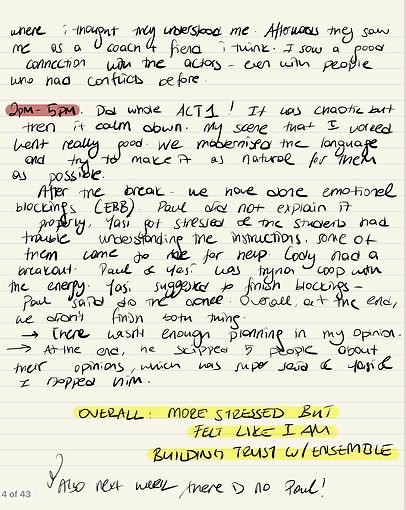

STRIKE DAY JOURNAL ENTRY


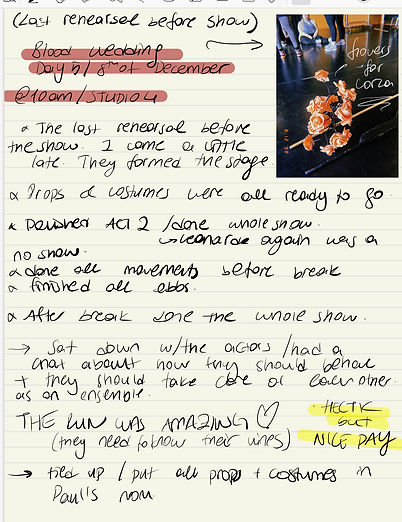


REFLECTION
This group is very much of a follower, rather than an explorer. As they are first-year students, they do not have the instinct to create without being told. The hierarchy of the group was different from what I expected. I had to think as a facilitator as well as a director. It was the collaboration where we lacked the most. I have learned most of my knowledge, in a group collaborating and thinking collectively. Because of the different dynamics and vibes of the group, this was not possible. I had to change my tactics throughout the day and had to put my facilitator hat on most of the time. Because of the dynamics of the group rather than being a collaborator I was the person to tell them what to do and decide for the group. "Collaboration is key in theatre. The director must be able to listen to and incorporate the ideas of others while still maintaining their own artistic vision." (Mitchell, 2009). While my focus was still being the collaborator in the room and making sure I heard everyone’s opinion, the project had to move forward while I had to take some initiative to make decisions.
It depends mostly on me, my performance, and my energy level. As a performer, I am responsible for my own energy level and how to keep it efficient. When I become the director of the room, my responsibility is divided into the whole cast, and I am responsible for the energy of the room. There were too many voices in the room as one student was confused because he did not have any lines up until week 7 of rehearsing, people asking questions about the strikes, and the confusion on their faces, when we couldn't block much without our director.
Later, I took the initiative and started with Act 2 while trying to send the updated script to Sofia. Overall, it was a very stressful but interesting day.
The idea of the strike being the constitution being unfair to the teacher as their pay and hour days and then a volunteer taking over to save the day was really interesting. At the end of the day, we found a new way to learn collectively, and I realised making some mistakes along the way was okay. As a person and as an artist I do not make decisions when I'm underprepared. But as I know now, you cannot be fully ready for a rehearsal day in the strike days. I found myself defending the strike as well as I felt bad for the students who were supposed to get a proper education in these years of strikes.
The strikes have been going on for a while and have been the core concern of the teaching industry with the current economic crisis. "The strikes have been a catalyst for renewed debate and activism around issues of higher education governance, accountability, and democratic participation, as well as the role of universities in wider society." (Hunt, 2019) Within the source of strikes, I had to adapt to many new situations expected my way. Protesting in any form and way is necessary within our modern society. To be able to merge performance and politics was really interesting as well. In higher education, it is almost undebatable to do strikes which students pay a lot of money for. To see it evolve like this makes me wonder what has not been changed around society and why we keep having the same issues. Hunt suggested the accountability of the politics relating to the universities in wider society in 2019. Even though this day had many challenges, for me, it was an opportunity to leas the rehearsal uninterrupted. These challenges made me realise how versatile I have to be in the rehearsal room to achieve the maximum outcome.
Phenomenology is a philosophical method that emphasises subjective experience and the study of consciousness. “As a methodological approach, phenomenology seeks to uncover the subjective meanings and structures that underlie our experiences, and to explore the ways in which these meanings are embodied in our actions and behaviours." (Zarrilli, 2002, p. 2). In rehearsal settings, phenomenology can be used as a tool to explore the inner experiences of actors and directors, which can help to inform their performances and understanding of a given play. The method can be used effectively even in the absence of the main teacher or director, as it relies heavily on the subjective experiences of the individual. The phenomenological method can also help to foster a deeper level of understanding and connection between actors and directors, as they work together to explore the complex inner worlds of the characters they are portraying. In the rehearsals, I tried to use this method to understand the group as quickly as I can in a teaching sense. Martin Heidegger, one of the most prominent philosophers associated with phenomenology, discusses the importance of phenomenology in the context of theater in his essay "The Origin of the Work of Art." He argues that art, including theater, has the ability to reveal the essence of things and help individuals to understand the world in a deeper way. Heidegger suggests that the phenomenological approach is particularly useful in this regard, as it allows individuals to explore the subjective experience of the artwork and connect with it on a more profound level. He argues that the work of art can reveal the truth of being and that it is through this revelation that individuals can gain a deeper understanding of themselves and the world around them. "In the work of art, the truth sets itself to work. The setting-to-work of truth happens in the work, as the work. The work is the truth, setting itself to work." (Heidegger, 2002, p. 17). In this rehearsal room I tried to use this methodology throughout the day with the idea of having a deeper level of understanding and connection with the actors.
As a reflection, I felt put off by the group because I was in the room as just a cover-up while still being another student of the university. In other ways I think I still handled it with care and as professionally as possible. "Volunteerism has become a central feature of the corporate school reform agenda, and it is being promoted as a way to supplement and replace publicly funded education programs." (Molnar, Halbach, & Hursh, 2018, p. 3) This has become an issue for a couple of years now, especially after Brexit. In a way, the best way to learn from your teachers is by being in the room while watching and assisting the class. But the accountability and the lack of authority in the class were noticeable. Where on each scene we worked we tried to set things up and did not want to lose a week of rehearsing, the whole idea of a strike is to make a statement to lose those days. I find myself in a dilemma in a way supporting the UCU Strikers and thinking they deserve everything they strike for but also I was feeling terrible for the students who paid 9k for this university and struggling with the classes. In an ethical way, I think I should have not gone to the class in order to make the strikes more understandable but at the same time, my work ethic was a little lower than my theatre ethics as the show must go on in any way… That we cannot lose a day of rehearsal when it is so close to the show date. At the end of the day, we did manage to get some work done and had a different dynamic class.
The next week when our director joined us, he changed a couple of the things that we already set but besides that, I think it was really helpful for the students to have that week with a different conductor and realise how differently they work with different artists. In a way, it was a first step for them in the real world. Things can change within minutes, and you always have to be prepared for that. The sad part of this process was the show was put on hold due to three cast members testing positive and all the hard work we have done had to be put on hold for 3 weeks. This rehearsal was a great lesson for me to realise how important it is to listen to the students and how that was the key to being able to do the rehearsal that day. The rehearsal process made me realise I have to adapt to any situation that will come my way and no matter what if I keep doing what I believe is right things will work out in the end.